Tuesday, August 10, 2010

Sink Your Teeth In


Illustration from Dinosaur Roar by Paul and Henrietta Stickland

I've always admired people
who bite off more than they can chew,
and then chew it.


Here's a scene I been chewin' on today:


Excerpt from Son of a Gun,
by
Marty Halverson

“You gotta take a bath, mister,” Black Pearl told the man standing by the bar next to Ruby. “There’s a tub down the hall, and Tequila’ll scrub your back and give you a shave. Wash your hair, too. I don’t want no lice in my pillows. This is a clean house.”

Tall and graceful, Black Pearl looked like she'd been carved out of melted chocolate. The girl turned her brown eyes on Ruby. Round as they were, the whites softened her appearance, as did the fleecy crown of black hair. “You’re Jewel?” she asked.

“Ruby.”

“We don’t go by our real names, much. Most of the fair sisters are eluding the law, or at least a peeved husband.” Black Pearl picked up Ruby’s suitcase and walked toward the stairs. “I read an obituary of a sprightly young bird called Louise in Dodge. Died of tuberculosis it said. And then, she turned up in Fort Worth, as rosy as a peach, going by the name of Lulu. She begged me not to tell a soul, since her daddy said he’d disown her after he killed her if he heard of her sharing her virtues again.” Her teeth flashed a dazzling white when she laughed.

“How’d you end up here?” Ruby asked.

“Husbands. When I find one, I end up running away. I didn’t have any in Sam’s Town so I figured it was safe.”

“Didn’t think anyone would want to marry a soiled dove, meaning no offense,” said Ruby.

“Everybody wants to marry us, Honey,” Pearl told her. “We understand men, know how to make ‘em feel special and loved. Course most of them drink too much, lose their shirts regular in poker games, and frequent places like this, so they don’t deserve decent women anyway. And we aren’t the kind of girls they want to take home to meet Grandma.” She chuckled, then added wickedly, “Especially if we already know Grandpa.”

Monday, August 9, 2010

How to Host a Tea Party for Kids

Hannah

An Oma Tradition

My eleven little granddaughters regularly host a tea party at my house. I bring the works, but they do the work. In fact, the work is the tea party. (Click here and you'll feel like you were an invited guest!)
Here's the ten step plan.


Literally.
The secretary makes notes of the plans.

There's nothing to do beforehand except go to the store.

Here's your list:
  1. Roll of paper: white wrapping paper, butcher paper, newsprint, whatever.
  2. Lots of washable markers.
  3. A roll of scotch tape for every two guests.
  4. A roll of crepe paper for every two guests.
  5. Bagels (one for each—I like the mini size. Get them sliced.)
  6. Tub of flavored cream cheese.
  7. Tiny carrot sticks, and a bowl of grapes (take them off their vines.)
  8. Craisins.
  9. Pink and white "Mother's" brand animal cookies with sprinkles.
  10. Plastic forks, spoons, little plates and napkins, a couple of little bowls to serve in.
  11. Big package of wipes.
  12. Seven-up
  13. Apple juice.

Decorating the Mural

This is the list of stuff I need to find in my house:
  1. Little chairs and tables
  2. Tablecloth to be used as dropcloth under the tables
  3. Dishtowels and dishrags (one per guest) and dish soap
  4. Plastic tea sets, with cups, saucers, spoons and at least one tiny pitcher for each guest.
  5. Full length mirror.
  6. Beauty Shop kit: (pink foam rollers, clippies, velcro brush rollers, several combs, spray water bottles, clips, headbands and ribbons.)
  7. Dress up kit: dresses, purses, costume jewelry, scarves, hats, plastic high heels. Make sure there's shoes and an outfit for everybody.
  8. Dollar store bracelets and flavored chapsticks for prizes.
  9. Music (piano, CD player, adults who will sing, whatever.)

It must fit the occasion.

Activities:
  1. Girls arrive and plan the tea party.
  2. Then they Make decorations: banner, twisted crepe paper streamers, everything made and taped by the guests at random.
  3. The girls set up the tables on top of the drop cloth, and then set out the knives and napkins, and plates. On each plate they put a carrot, grapes, craisins, a bagel and a scoop of cream cheese. The animal cookies are saved for dessert and so is the "tea."
  4. When the food is ready, they go to the beauty shop and do their hair.
  5. Then the dress shop to pick their outfits.
  6. An impromptu fashion show introduces each guest, and they are seated for the tea party.
  7. After a prayer, they spread their own cream cheese on their bagel, and eat.
  8. I read Fancy Nancy, Madeline and other girlie type stories while they nibble politely.
  9. Then the teapots appear. Each girl gets a creamer filled with 7-up (cream) and a small teapot of apple juice is shared by 4 girls at a table. Tiny plastic cups, saucers and spoons make this the highlight event of the day. They get to do all the pouring. We serve the cookies and they discuss where they're from "I'm from Malaysia." "I'm from Lava Hot Springs." They make up stories and every place sounds exotic.
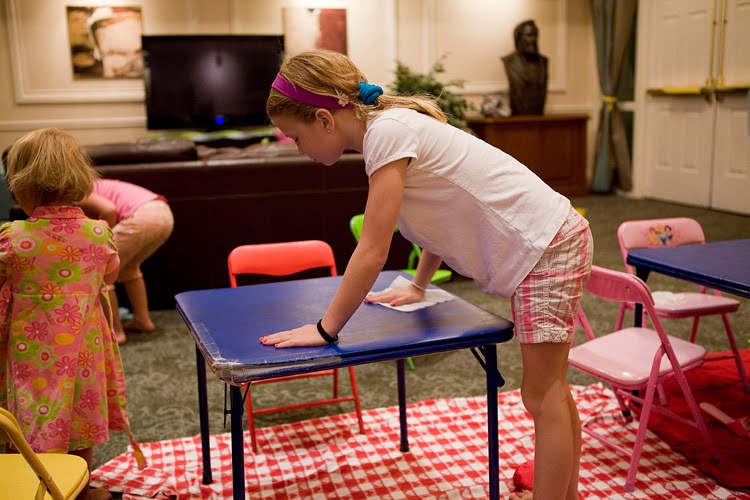
  10. Clean-up is an activity in itself. They rip down the decorations, carry the plates to the sink, scrub their hands, faces, and the tables and chairs with wipes. Then a couple of girls wash the dishes in soapy suds and the other girls carefully dry each piece, and pack them in the tea party kit. Dress-ups are stuffed back into the trunks. Garbage is collected. It's fun to use a timer and split them into teams and make it a contest.
  11. Prizes are passed out after the clean up: dollar bracelets, and fruity chapsticks.
  12. Freeze dance: This is the wind down. They dance all over, and when the music stops they freeze in position. During this activity I clean up the clean-up.
Clean up time.

Time to go! Bye, bye cute girls.
Thanks for hosting an Oma Tea Party!
See you next time!
(Easy- peasy, lemon squeezy!)


Please visit Christie's official

Tea Party Documentary

(Wear heels, and keep your pinkie up.)


Friday, August 6, 2010

Pioneer Trek: Second Story in Honor of Amy


From Under a Sunbonnet: 1990

Against my better judgment I became a pioneer woman for a week. Our church youth group recreated a Pioneer Trek, complete with sunbonnets, bloomers, aprons and handcarts. As a leader I was expected to be part of the four-day activity as a chaperone, even though the teenagers would be divided up and grouped as families with kids they didn't know.

Specially trained young adult couples played the parts of Pa and Ma, while the legitimate adults were assigned to accompany each family as participants. I had a 16-year-old son and a 14-year-old daughter who were excited to go, so I reluctantly agreed to join the group. I knew we wouldn't be put in the same trek family, but we would have a shared experience and that was a good enough reason.

It was a grueling first day. The kids started out with energy. I started out tired. We put together our own handcarts and loaded them with supplies. Since they weighed several hundred pounds, each member of the family was supposed to help pull or push the handcart on the 13-mile hike.

Ours was one of the first wagons in the train and we set off with vigor. Excited jabbering and singing was heard down the trail behind us. By 2:00 in the afternoon the little enthusiasm I had had early that morning was gone. It was 100° and I was out-of-sorts with exhaustion, and hunger. Some of the kids were whining and complaining and I identified with them.

I started dragging behind, walking slower and slower as the other handcart families passed me by. Whose idea was this anyway? Why would we take a bunch of teenage kids into the wilderness and subject them to such hardship? I felt disoriented, lightheaded, and miserable.

The trail boss, a man I respected and trusted, noticed me and led me over to a stream where he soaked my bandanna in the cold water, and gave me a canteen of Gatorade. He suggested I ride in the support vehicle behind the group for a few minutes to regain my strength.

Relieved of my sunbonnet, in the air-conditioned Suburban, I cooled off quickly, and chatted with the driver, a good friend who was a physician. He assured me I would make it, so a few minutes later he caught up with the group and let me out, and then dropped out of sight again.

I walked a little faster, passing other handcart families to reach my own. Instead of the flat trail we had been walking all day, we were now going up a mountain. It got steeper and rockier, and was difficult to navigate in a long skirt. Soon I was actually scrambling on all fours, climbing over the rocks. I had passed one group and now I was behind a handcart that perched precariously on some rocks. It was off balance, and the kids in front were pulling while others were behind, trying to push.

Suddenly I noticed that it was quiet. The ma's and pa's had asked the trekkers not to talk. The kids had to negotiate the handcarts on this difficult stretch silently, cooperating by observing their companions, and just doing what became obvious to them. Then the pa's whispered to the boys that they could not participate in the work. It was time for the Women's Pull.

We had been forewarned that there would be a section of the hike where the girls pulled the handcarts alone. Of course it was highly anticipated. The young women were anxious to show off their fortitude and stamina to all the guys. However, the results were not anticipated.

The mountain was the most demanding area we would encounter. Everyone was tired, and shaky from heat and exertion. Going up the steep, rocky slope the families had needed everyone's strength, and now it was cut in half. The boys witnessed the trouble the girls were having; some ran for water, and others whispered encouragement, and went ahead to move big rocks out of the way. The girls had resilience, and discovered new muscles emotionally and physically, tears running down their cheeks as they exerted courageously. The young men were overwhelmed with respect, wondering if they could have risen to such a challenge.

I'm embarrassed to say I didn't have the energy to help. Getting myself up the hill was all I could manage. I was several yards behind a handcart that began to tip. A tiny girl, her face shaded by a big sunbonnet, supported it from behind. I watched as her feet dug into the dirt between the rocks, her back hardened and her shoulders tensed. Her arms clenched while she
pushed the wagon with force and determination. With the help of the girls in front pulling, she jostled the cart up and over a giant boulder in the path.

For a moment she caught her breath and wiped the sweat from her forehead. As she lifted the brim of her bonnet I saw it was Amy, my 14-year-old daughter.

Even after 22 years, the lessons of my Pioneer Trek continue to unfold in my mind. I would never have expected such inner fortitude of young city slickers; we all stumbled on power hidden deep inside ourselves. The experience demonstrated potential and capacity, and I know we can do impossible things when we need to. And so can our kids.

Sometimes the most help we can give someone is to let them do it on their own. Desperation can be the source of motivation. A person who is balancing their whole world is more careful about where they place their feet. I learned that from a girl in a sunbonnet.


Amy Las Vegas 2010

The girl in the sunbonnet turned 35 today (technically yesterday, but I'm taking the celebration to a new level.) I'm continually in awe of her strengths and how she uses them to strengthen her family, and influence people for good. Happy Birthday, to my dazzling daughter!


Thursday, August 5, 2010

Through a Historian's Eyes

Sign In

Historians can't be near-sighted;


Drops

Things are blurry when they're too close.


Dress for the occasion

Dee had eye surgery this morning,


Thirty minutes later

No blood, no pain . . .

One hour later—look at that!

But a whole new perspective.

Dee has always envied my 20/20 vision, but he's taught me to see things through a historian's eyes. Whenever I fret about the state of the world, he reminds me that it's all happened before, and that we can learn from the past.

Prejudices have come and gone in our country, and it seems like every generation has to learn the same lessons. These days Hispanics are being profiled and stereotyped, but a hundred years ago Italian and Irish immigrants took the brunt of racial aversion. Chinese people were only allowed in the USA to work on the railroads. Before "political correctness" was a concept, Jews and Poles were punchlines of rude jokes, and John F. Kennedy was feared because he was a Catholic.

Remembering history is a perk of getting old.

When I was a little girl, a Japanese-American couple put an offer on a house on our street. (This was Salt Lake City in about 1958.) Our suburban neighborhood had restrictive covenants that didn't allow Japanese people. Even though they were born in Hawaii and California, and the husband had served in the army in World War II, they looked Japanese, and therefore were not welcome.

A petition went around to keep them from buying the house. Ironically, a woman from Indonesia (not yet an American citizen) headed the attack. I remember a meeting in our living room where the neighbors (all upstanding church-goers) gathered to discuss the problem. The prevailing view was that property values would go down if these kinds of people were tolerated.

Well, the couple didn't buy the house.

This particular woman has since become very prominent in our community. People buy her books and line up to hear her speak. When she refers to the humiliation they faced in the 1950's because of their race, there is a hush in the audience. Who would be so racist, so condemning, because of their foreign sounding name or the shape of their eyes? It seems unthinkable, now, knowing who she is. Unfortunately, nobody in my neighborhood knew who she'd become.

Looking through a historian's eyes, we were a little near-sighted.

More perspective tomorrow . . .


Tuesday, August 3, 2010

Childish Games: (Your Thoughts, Please!)


"Tick tock, the game is locked.
Nobody else can play but us . . ."

On the way home from the dentist that day my mom bought me a purple and blue marbled rubber hoppy-taw. It landed with a satisfying slap on the hopscotch she drew in our driveway with white chalk.

Karen and Linda came over and we practiced our expert throws, skillful jumps and precise turns in preparation for the fifth-grade competition. It was annoying when a couple of little sisters begged to join the game. So, we joined hands and locked them out.

Afterward we went out of our way to demonstrate all the fun they were missing, showing off our solidarity in excluding them. Were we cool or what??

Apparently not. Mom came out and took away the hoppy taw. It had been a gift from her, and she didn't like the selfish attitude I had in using it. She scuffed out the hopscotch, sent my friends home and told me when I learned to play with my little sister I could have my grown-up privileges back.

Mom taught the lesson over and over. "Do unto others as you would have others do unto you."

That's why my shoulders tighten and my stomach churns when I hear the angry voices on the immigration issue. Although the arguments make it sound complex, to me it boils down simply: I'm not more special than anyone else, and I'm supposed to share the blessings I've been given.

This is the introduction to a recent series on KSL TV on immigration.

The Dream Divided
It is an issue that affects every American, and everyone who would become an American. And while it touches a thousand aspects of American life, it has managed to divide America into two camps.
One which believes our national borders are there to protect a way of life. Another which believes there should be no hard borders for those who strive honestly for freedom and opportunity. One side believes our nation is made weaker when the Rule of law is not enforced. The other believes our nation is made stronger by those who come here to build a better life. Neither side is right; neither side is wrong. It is a battle of perspectives, influenced by many factors -- compassion versus concern over safety, economic stability, the integrity of our culture. It raises a fundamental question about what we call "The American Dream." Does it envision a place of refuge, or place that ensures the security of those already here? The most important question: Is there a place in the middle? That is the question, and while the debate rages, the Dream is Divided...

From my perspective, it's wrong to join hands and lock somebody else out, just because I started playing first. That's a childish game.


*I'd love to hear your comments, whether you agree with me or not. This is a subject worthy of a serious back and forth discussion. Although I usually don't comment in my own comments, I'm excited to respond to your thoughts. Tell me how you feel about all this!

Monday, August 2, 2010

Write Away

Things you can't do when you're writing a novel:
  1. Sleep
  2. Talk on the phone
  3. Cook dinner
  4. Surf the net
  5. Go shopping
  6. Put on make-up
  7. Read a novel
  8. Pay your bills
  9. Make your bed
  10. Write a decent blog post.
Things you can do when you're writing a novel:

Have so much fun writing a scene that you forget to eat.


“So, what’s your real name, Turk?” Ruby said.

“Ain’t you ever heard of courtesy, girl?” Turk asked, surprised.

“Laws, I was raised on courtesy! When I was a girl and a stranger showed up at our ranch, Ma always offered food. And my daddy gave him tobacco. In fact, he tacked a note to the door when we was gone that said, ‘Help yourself to grub—please feed the chickens.”

Turk smiled. “What if they was on the dodge from the law?”

“Most of ‘em probably was, but my folks allowed them their privacy. After one cowboy had finished his dinner I asked him what his name was. ‘Jones is the name,’ he said. As soon as he rode off, Ma laid into me for being so ill-mannered as to ask any man his name.”

“So why you askin’ me, if you know it’s an impoliteness?”

“Because you’re not a stranger—you’re a friend.”

The old man looked at Ruby fondly. “It’s ‘cause you’re a friend that I’ll keep it to ‘Turk.’ Don’t want you influenced by my past.”

“You think I’d judge? After all the mud I’m draggin’ through? Come on, how’d you turn into a cook? Just tell me that.” She got out a cigar and handed it to him. “Let’s set outside a bit,” she said, knowing he couldn’t resist a smoke and an audience at the same time.


"The secret of success is to get up in the morning,
and go to bed at night,
and in between do something you want to do."
Bob Dylan

*Homework:

~Make a list of ten things you want to do.

~Do one of them today.

~Enjoy success!


Friday, July 30, 2010

What Can You Do?

Marta, 2010

mwrites is on a quest to make us feel good about ourselves with her How-To Series. She says:

"the how-to series was created to encourage confidence in creativity. to focus on what we can do rather than what we can't. i am excited to showcase your talents and unique ideas."
'Do not let what you cannot do interfere with what you can do.'
- John Wooden

She invited her readers to send a guest post on something they know how to do. They responded big time, with how-to posts on a huge variety of topics: how to cut a birthday cake, how to cope with losing a baby, how to photograph a child, how to shop for swimsuits and many more.

Today I was featured. I explained How to make an Oma kit. Check it out, and think about the hundreds of things you know how to do. (We're all pretty awesome in our own way.)

Marta and Marty show how to eat dough.

Thursday, July 29, 2010

Grandkid Time

Oma and Opa
"The Opi's"


July has been a Grand month—
grandkids have come from far and near to entertain the Opis.

Oma: Do you know how to work our remote?
Mack: Are you kidding? I'm a child of technology!

Oma: When I was little we didn't have a hair dryer, so I wore curlers to bed.
Lucy: Was that back in the '90's?

Opa: We'll leave at 8 o'clock a.m.
McKay: Uh-oh. That's not Oma's happy hour.

Actually, any hour with this group is my happy hour. They show me how to work an iPad and how to play Rock Band on the Wii, and I show them how to play jacks. (The age of technology meets the dark ages.) Here's the grand run-down:

An old-fashioned water park.

Sprinklers, squirt guns and wading pools.
(Notice the queue for the water slide.)

Followed by Heidi's homemade pies.


Cat's Cradle:

A loop of string captivated their attention,
for hours. Literally!

They watched each other until they caught on,
and then they partnered up.


A production of Bye, Bye Birdie
in the local park.

These girls invited me to the live performance. It's one of their favorite movies. Chelsea said, "I have all the songs on my iPod." Lucy said, "Her iPod doesn't even work." "But I still know all the songs," retorted Chelsea.

Halfway through the play Lucy said, "I thought Dick Van Dyke was supposed to be in this."


Clapping Games:


Like playing the banjo and whistling with my fingers,
this is a skill I've always wanted but never had.

But I remember all the chants:

Say, say oh playmate
Come out and play with me
And bring your dollies three
Climb up my apple tree
Slide down my rain barrel
Into my cellar door
And we'll be jolly friends
Forever more - more - shut the door!

Say, say oh playmate,
I cannot play with you.
My dolly has the flu,
Boohoo, hoohoo, hoo, hoo.
Ain't got no rain barrel,
Ain't got no cellar door.
But we'll be jolly friends,
Forever more, more, shut the door!

One of the grand responsibilities of grandparent-hood is passing on some old-fashioned traditions. You know, from the 90's.

Naptime:


We're going to try this in August.


P.S. All these activities happened because of our fabulous kids. The only thing I contributed was the string.


Wednesday, July 28, 2010

Daughters

Idaho Wheat

"Oh, the comfort, the inexpressible comfort of feeling safe with a person,
having neither to weigh thoughts nor measure words,
but pouring them all out, just as they are, chaff and grain together,


Certain that a faithful hand will take and sift them,


Keep what is worth keeping,


And with a breath of kindness blow the rest away."
---Dinah Craik


Tuesday, July 27, 2010

A Novel Post

Oma at work

Your whole novel is right inside your computer. You just have to be able to hit the keys in the right order. Lately I feel like I'm squeezing words out of rocks. (Dee says that means my writing is solid.) I've got about 170 pages so far. Here's a little sample:


Jack and Big Red

An excerpt from

Son of a Gun

by
Marty Halverson

Greenville was a two-day ride through sage and Indian paintbrush. Jack reversed his bandanna and pulled it above his nose to cut the trail dust, and settled down to the long day’s grind. The coolness of night had gone completely from the desert, and sunlight began to bite his skin.

After collecting his wages from Luke Gollaher, he’d strapped his possibles sack and bedroll on Big Red, and set off before dawn. At noon he threw off for an hour, eating cold bacon and bread by the wet seep of a spring.

“Red, what would Mama think of us now?” Jack always talked to his horse when they were far from civilization. She listened well, and seemed to bounce back the responses he was hoping for.

“She’d have me hell-bound for killing a man. I’ve done most of God’s sins. Heck, after Indian Joe I’ve prob’ly done ‘em all. But here I sit, as fresh and fit as a boy could be. No devils with little pitchforks after us, far as I can tell. Maybe Mama was wrong about God caring about all that.” Heat crowded around him, and the soil glittered between its patches of rock and dried bunchgrass. “Or maybe God just don’t care much about me.”

To the west the desert looked smoky with dark, dry clouds; to the east the near-by buttes baked, barren and arid. Twice riders appeared in the far distance, stirring up vague spirals of dust. In the middle of the afternoon a band of antelope scudded down a sterile draw and crossed the trail with the speed of gusty wind, racing into the desert. Four piled cattle skulls marked the turning to Greenville. At dusk of that long day Jack came to a shallow crossing of the Brazos that lay half-hidden in the junipers.

After a supper of bacon and canned tomatoes, he settled back to smoke away the last of the day’s light. The stars were shining out of a black sky and the night wind turned quite cold. Wilderness winds and coyotes were calling out of the near hills. Jack’s thoughts ran freely and odd, and a little sad.

Pressed in by the dark a man’s mind gets close to his mortal questions. It wasn’t often that Jack thought of his mother, but he remembered her telling him that large, fragrant, white flowers bloomed on the triangle cactus at night, closing up by morning. He was like that; the stars and moon brought out a tender side in him that also disappeared when the hot sun beat down.

“You miss your mama, Red?” he asked the horse. “She was a pretty one, just like mine was.” The mare only laid full on the ground every other day, and then for just a little while, but tonight Jack had his head propped on her belly. “You think they’re together up there, ridin’ Hank amongst them heavenly clouds?” Big Red snorted and Jack caressed her muzzle.

“Don’t think I could ever love anybody like I did that boy. He put such stock in me . . . shoot . . .” he muttered as he stirred the fire. “I’m getting maudlin, Red.”

Loneliness touched his nerves and got in his bones. “Here I’m talkin’ to a horse!” He took off his boots and stuck them on two sticks to dry out. “Tomorrow I’m lookin’ for a different kind of pony-tail,” he told his only friend.


Jack made good use of the next day’s travel time. Every movement in the purple squaw-weed gave him a target. When a lizard scurried among the black-eyed Susans, he pulled his .45 and sent it flying. At midmorning, he ate some beans, then set the empty can on a tree stump and knocked it off with one bullet. Later, when a diamondback slithered in the scrub brush, Jack’s left finger pulled the trigger. Six shots divided the snake into pre-cut chunks for lunch.

His fast draw seemed to be inborn, but he made the most of it by practicing. He couldn’t remember a time he wasn’t shooting snakes or squirrels, blue jays or black crows. It got so he even let them play his game. If a bird wasn’t flying, he kicked up some leaves to scare it off the branch and into the air before he brought it down. He shot without hesitation, with the intent to kill. Aiming his dark blue Colt was akin to pointing a forefinger.

“First off in town, we need us some bullets,” Jack told Red. “Then one of us is takin’ a bath.” Farms and ranches were getting closer together, promising civilization within the hour.


*Homework:

~Write a novel, one excruciating word at a time. (By the end you'll start getting the hang of it.)


Friday, July 23, 2010

Pioneer Day

Looking straight down from our balcony 7/24/09

I looked out my window, and what did I see?
People sleeping underneath my tree!

Thousands of people camp overnight on our sidewalk to reserve their parade spot.

There's a story that's told once each year,
And folks come from everywhere just to hear.

Parade breakfast at Oma's

Don't fuss getting ready,
But come early to eat,

The Grand Stand

And you'll have a view that can't be beat.

One of 121 parade entries

The chapters pass by, the bands get loud cheers,

"Where are the bonnets, Oma?"

And everyone remembers the pioneers.

For 24 hours every 24th of July we have the hottest real estate in Utah. Our balcony overlooks the traditional Pioneer Parade (the 3rd largest parade in the USA!) and the local grands sit in our grandstand.

The 24th of July is a day of stories. Everyone in Mormondom has heard heart-wrenching accounts about the pioneers who left Nauvoo and trekked across the plains in covered wagons. There are soul-stirring tales about people who joined the Church of Jesus Christ of Latter-day Saints in England, Scandinavia and Europe. Families sold everything to afford passage, and sailed to America to join the Saints. Because they couldn't afford wagons, they pulled handcarts and walked the whole way. Miracles abound in these oft-told stories, but sometimes they lose their significance in the repetition.

C.C.A. Christensen

A few years ago I wrote a book called A Lasting Legacy, tracing my family history back to 1628. I loved reading and working from original documents and journals. One of my ancestors was Andrew Jackson Allen, born September 5, 1818 in Pulasky County, Kentucky. He started keeping a daily journal when he was 38 years old.

One of the original pioneers, he arrived in the Great Salt Lake Valley November 25, 1847, just four months after Brigham Young told the first company, "This is the right place." The Allen family built a log cabin and lived through the winter, eating mostly flour and bulbs.

In 1848, long before anyone was telling this story in Sunday School, he wrote down his own experience with the Miracle of the Seagulls:

May 7, 1848
Now every man went in for farming. There were a field laid out large enough for all. We put in our spring wheat, corn and what few potatoes we had. We had to irrigate, which we had never done before. Now we needed to grow grain, or suffer, as there were no grain nearer than one thousand miles away and my provisions were getting short. When wild vegetation sprang up, the people had to go to the prairies to seek roots to eat, such as field onions and thistle roots which were not pleasant, but hunger made them taste good. There were some folks to my knowledge that ate large white wolves.

Now we commenced making water ditches for irrigation. The spring grain sprung up and looked quite good. The next thing we see was thousands of young crickets making their appearance in every direction. We discovered they were eating at the young growing wheat and gardens. We began to destroy them in every way we could, but all in vain. It really seemed as though the more we killed, the more came. It seemed as though they would destroy all we put in the ground in spite of all we could do.

May 20, 1848
There was a cold snap that froze the vines, and things in the ground were easily killed. Now the fall wheat we had got was just beginning to put the head out of the ground and the frost killed it. This was a trying time. Those crickets also were eating at the fall wheat. Many of us were out of bread. Just now the seagulls came in flocks by the thousands and began to eat the crickets. They would cover the fields and fill themselves and then they would fly to the water and drink, then they would vomit them up and go again and fill up again. They seemed to repeat this time after time after time, and soon they destroyed the crickets in a great measure. We attributed this to the hand of the Lord in our behalf. If those gulls had not destroyed them, they would have destroyed all of our growing crops. And that would have brought great suffering among the people.

This guy was pretty great: my great-great-great-great grandfather. He touched on a huge variety of events: the death of Joseph Smith, the civil war, the assassination of Abraham Lincoln, the "tellegraft wire," the coming of the railroad, and the shot that killed President James A. Garfield.

He wrote "one of my little boys, 19 months of age, had been sick but got better. Was taken worse and at 8:00 am he departed this life." And a couple of years later: "My daughter, Purlina, were taken very ill with her old leg complaint. I done all for her I could, but all in vain. She departed this life at 7:00 pm, perfectly in her right mind, reconciled to her fate. Her age was 12 years and 11 months."

Andrew Jackson Allen died at age 66. The obituary said, "He was gored to death by a vicious bull." It's a horrible end, but it makes a great story.

The Bible tells us that our hearts will turn to our fathers. I believe it. Joseph Fielding Smith said, "It remains the responsibility of each individual to know his kindred dead . . . it is each person's responsibility to study and become acquainted with his ancestors." Compiling dates isn't enough. "We are, after all, not simply clerks recording their passing. We are their family." (Brent Barlow, July 2009 Ensign)

I've got a parade of descendants marching as fast as they can into the future. I'm going to take a page from my own book, and this week I'll record a few personal miracles. After all, right now I've got an audience.

The Grand Parade.