Showing posts with label Motherhood. Show all posts

Tuesday, August 14, 2012

Kidspeak


While we were gone, baby Seth joined our family.
Marta is Seth's mom, and Dan is Seth's dad.


Benji is Seth's big brother, and he came for a sleepover last night. Dee graciously let Benji share the master bedroom with me, and I made him a comfy bed on the floor with a feather tick, quilts and several fluffy pillows.

"Who's sleeping there, Oma?" he asked.
"You," I replied.
"Well," he said, "I could sleep in the bed."
"I thought I'd sleep in the bed," I said.
"Well, it's big enough for two," he said.
"Really?" I said.


He's learning to share his mom and his dad.
It might be too much to expect him to share his bed!
(The floor wasn't that comfy, by the way.)

Welcome to Seth Wells Dansie
Cousins Club Member #22


Read Marta's beautiful new-baby post here.


Tuesday, June 12, 2012

Do Something Hard


From Under a Sunbonnet: 1990

Against my better judgment I became a pioneer woman for a week. Our church youth group recreated a Pioneer Trek, complete with sunbonnets, bloomers, aprons and handcarts. As a leader I was expected to be part of the four-day activity as a chaperone, even though the teenagers would be divided up and grouped as families with kids they didn't know.

Specially trained young adult couples played the parts of Pa and Ma, while the legitimate adults were assigned to accompany each family as participants. I had a 16-year-old son and a 14-year-old daughter who were excited to go, so I reluctantly agreed to join the group. I knew we wouldn't be put in the same trek family, but we would have a shared experience and that was a good enough reason.

It was a grueling first day. The kids started out with energy. I started out tired. We put together our own handcarts and loaded them with supplies. Since they weighed several hundred pounds, each member of the family was supposed to help pull or push the handcart on the 13-mile hike.

Ours was one of the first wagons in the train and we set off with vigor. Excited jabbering and singing was heard down the trail behind us. By 2:00 in the afternoon the little enthusiasm I had had early that morning was gone. It was 100° and I was out-of-sorts with exhaustion, and hunger. Some of the kids were whining and complaining and I identified with them.

I started dragging behind, walking slower and slower as the other handcart families passed me by. Whose idea was this anyway? Why would we take a bunch of teenage kids into the wilderness and subject them to such hardship? I felt disoriented, lightheaded, and miserable.

The trail boss, a man I respected and trusted, noticed me and led me over to a stream where he soaked my bandanna in the cold water, and gave me a canteen of Gatorade. He suggested I ride in the support vehicle behind the group for a few minutes to regain my strength.

Relieved of my sunbonnet, in the air-conditioned Suburban, I cooled off quickly, and chatted with the driver, a good friend who was a physician. He assured me I would make it, so a few minutes later he caught up with the group and let me out, and then dropped out of sight again.

I walked a little faster, passing other handcart families to reach my own. Instead of the flat trail we had been walking all day, we were now going up a mountain. It got steeper and rockier, and was difficult to navigate in a long skirt. Soon I was actually scrambling on all fours, climbing over the rocks. I had passed one group and now I was behind a handcart that perched precariously on some rocks. It was off balance, and the kids in front were pulling while others were behind, trying to push.

Suddenly I noticed that it was quiet. The ma's and pa's had asked the trekkers not to talk. The kids had to negotiate the handcarts on this difficult stretch silently, cooperating by observing their companions, and just doing what became obvious to them. Then the pa's whispered to the boys that they could not participate in the work. It was time for the Women's Pull.

We had been forewarned that there would be a section of the hike where the girls pulled the handcarts alone. Of course it was highly anticipated. The young women were anxious to show off their fortitude and stamina to all the guys. However, the results were not anticipated.

The mountain was the most demanding area we would encounter. Everyone was tired, and shaky from heat and exertion. Going up the steep, rocky slope the families had needed everyone's strength, and now it was cut in half. The boys witnessed the trouble the girls were having; some ran for water, and others whispered encouragement, and went ahead to move big rocks out of the way. The girls had resilience, and discovered new muscles emotionally and physically, tears running down their cheeks as they exerted courageously. The young men were overwhelmed with respect, wondering if they could have risen to such a challenge.

I'm embarrassed to say I didn't have the energy to help. Getting myself up the hill was all I could manage. I was several yards behind a handcart that began to tip. A tiny girl, her face shaded by a big sunbonnet, supported it from behind. I watched as her feet dug into the dirt between the rocks, her back hardened and her shoulders tensed. Her arms clenched while she
pushed the wagon with force and determination. With the help of the girls in front pulling, she jostled the cart up and over a giant boulder in the path.

For a moment she caught her breath and wiped the sweat from her forehead. As she lifted the brim of her bonnet I saw it was Amy, my 14-year-old daughter.

Even after 22 years, the lessons of my Pioneer Trek continue to unfold in my mind. I would never have expected such inner fortitude of young city slickers; we all stumbled on power hidden deep inside ourselves. The experience demonstrated potential and capacity, and I knowwe can do impossible things when we need to. And so can our kids.

Sometimes the most help we can give someone is to let them do it on their own. Desperation can be the source of motivation. A person who is balancing their whole world is more careful about where they place their feet. I learned that from a girl in a sunbonnet.


Think about a time you did something hard. Are you in the middle of a Pioneer Trek experience right now? Write about it. Discover what you're learning. If you write about it, you can learn from it the rest of your life. Eventually you'll see the hard thing as one of the great blessings in your life.


Thursday, April 26, 2012

Life in the Motherhood


Who are all these kids and why are they calling me mom?

I used to be this woman: young, formerly cute, with a bad attitude and a mean face. I started out with great theories on raising kids. Then one day I found a 25-pound bag of sugar spread evenly on the storage room floor. The kids and their friends were ice-skating in their socks over the slippery crystals.

Chalking it up to bad outside influences, I kept them isolated from naughty neighbor children. The next thing they designed was a swimming pool. They covered the shower drain with a towel and let the water overflow onto the bathroom floor. The plan was to fill up the bathroom and swim like fish in an aquarium. The resulting flood ruined the tile, and the carpet in the next room.

Experts on child-rearing have never bothered having children. If they did, they'd know nothing works. My theories toppled like blocks in a playroom.

When the corner of the boys bedroom started attracting flies, I investigated. Hmmm ... what was the stinky, sticky liquid that had stiffened the carpet and eaten away the carpet pad ... even the floor boards were dissolving ... Could it be that animals lived in this room and had marked their spot with urine? These could NOT be my children! My children were obediently doing their extra reading at bedtime, not filling their toy box with bodily fluids!

Insanity is hereditary. You get it from your kids.

There were emotional issues, too. One kid had a conniption fit when the tub drain was released, convinced that he and all of his loved ones would be sucked down pipes and live in the sewer muck forever. He could hear the plug being released from any room in the house and broke into screams of terror. Another kid refused to take baths. He sat fully clothed on the bathroom floor and stirred the bathwater so it would sound like he was washing his sweat-stained arms.

Fears of wind, car washes, and vacuums ran rampant at our house. Two kids "rolled" their heads in a rhythmic effort to sooth themselves to sleep ... for hours every night! I sat in darkened bedrooms to scare away bad dreams, and laid in darkened doorways to rescue sleepwalkers.

My bad dreams involved taking them out in public. Mom rearranged the furniture one year for Thanksgiving. She hauled the ping-pong table upstairs to the dining room, and set it with her lovely silver and china. The meal got underway, with instructions on where to sit and thanks to great-grandma for her homemade watermelon pickles. "Everybody fold your arms. It's time for the prayer."

I scanned the room for my cute little boys while my sister searched for hers. Suddenly the decorative metal room divider lurched towards the table. As we all looked up in horror we saw four little monkeys clutching the aluminum scroll-work as it fell from it's place between the ceiling and the half-wall. In the nick of time, our husbands caught it before our sons became the centerpiece. Turkey time.

I childproofed the house but they keep getting back in.


I'm not telling these stories to brag. I just want to establish my credentials as an honest-to-goodness mom. Thirty years of on-the-job training taught me that most naughty behavior is just a stage. Happily all seven kids grew out of all conduct unbecoming, and now it's entertaining to watch them deal with their own little rascals.

But what do you do between "the baby just rolled over!" and "he's going away to college?" My dad used to say, "Just love 'em, and make them mind." So, how do you teach them to mind? What works? Time outs, grounding, incentives, threats, taking away privileges, little chats? What's fair? What if you're inconsistent? Is there a place for spanking? (If I was a young mother now I'd be turned in for child abuse for sure.)

(All illustrations here are from the darling book Jillian Jiggs, by Phoebe Gilman.)

As a parent or grandparent, you've been on the front lines and your experience, good and bad, is valuable. If you're not a parent, you were a kid. How did your parents handle tantrums, lying, bad grades, curfew, swearing, speeding tickets or whatever your vice happened to be?

Share!


Thursday, April 5, 2012

Intentional Motherhood

Micah, Josh, Amy and Heidi, 1978

I was an intentional mother—I knew what I wanted to have happen and I thought of ways to make it happen. Here's one of my success stories:

Twice a week I hung a sign on our front door that said Halverson Hero Happening! It was a family after-school party—because it was named, it was special. Then, I acted excited! "Hi guys! Did you remember we're having a Happening?" They were caught up by my enthusiasm.

I directed them to hang up their coats, give me their papers, etc. "Quick! We have activities planned!" First we'd go to the Treat Cafe (normal after-school snacks served by a waitress. I'd recite the menu and they'd place their orders, sitting at the counter like customers.) With the phone off the hook and a "We're busy today," sign on the door, we had time to chat.

Next we played games—naming them made all the difference.

Minute Reports—the timer was set for one minute and each kid had a turn to tell as many things as they could about their day. Someone watched the timer and someone kept track.

Story Time—
We'd sit on the floor in a circle and I'd tell an ancestor story, or one about an upcoming holiday, or a story with a moral, or a funny poem, or just a knock-knock joke. Something fun.

Homework Hop
—each kid had to hop on one foot for as long as it took to tell what their homework was.

Laundry Prize—each kid put away their laundry and would find a piece of bubble gum, or a lollipop at the bottom of their individual basket. It was a race to get back to the family room first.

Chore Challenge
—each kid drew a chore from a hat and had five minutes to do it well, and return and sit down. Then we'd all inspect each chore and decide if it passed inspection. If it did, the kid got a star on the job chart.

Talent Showoff
—each kid performed something they were supposed to practice (a piano piece, a violin solo, a gymnastics trick, a multiplication table) and we all clapped.

Free Time—
I assigned partners or trios of kids to invent an activity, which they could play together as long as they didn't bother another partnership. When the inevitable melt-down came, I'd gather the group again and they'd all report on their activity. By then the magic of the Happening had dissipated and we'd break up into homework, practicing, TV, whatever til dinner time.

Happenings met our needs. The kids wanted my full attention after school. When they got it, they behaved. I wanted their full attention after school and when I got it, I behaved. The whole afternoon went smoother. (To be totally honest, this did not work all the time. But it worked enough of the time for me to call it successful.)

The kids had to deal with peer pressure—telling friends they couldn't play was embarrassing. I had my own peer pressure: telling friends "I've reserved this time for my kids," was hard for me. But this was valuable time and I didn't want to give it away. I consolidated lessons as much as possible so we'd have a couple of un-pressured afternoons a week; sometimes I bagged lessons altogether for a season in favor of a less chaotic home life.

Motherhood was a career choice for me, not something on the side. Because I viewed it this way, I could excuse the parts I wasn't thrilled about—every career has its downsides—and concentrate my efforts where my personal talents and interests lay.

"The greatest aid to adult education is children."
—Charlie T. Jones


Wednesday, April 4, 2012

Family Easter Egg Hunt

"Dear! I think you're the Easter Bunny!"

Grama Lundgren used to have an Easter Egg Hunt in her gigantic front yard for 24 grandkids. She spent hours boiling, dying and hiding a dozen dozens of eggs; we spent ten minutes running wildly through the apple trees in our Easter bonnets and bow ties; then we all spent days eating egg salad sandwiches. The work-to-fun ratio was out of balance, so I tweaked the tradition. An Oma Party always includes the preparation: instead of doing the work myself, I let the guests do it—that becomes the party! Let me explain.

Back when I was a full-time mom, I'd often announce a Halverson Hero Happening. Our family gathered in the kitchen (we were a party of nine) for a planning session, assignments were made, and the festivities began. Scotch tape, balloons and crepe paper appeared; pudding was instant (with lots of squirt whipped cream) and games were assembled. Fifteen minutes later colorful streamers and excited screamers filled the family room—the party had planned itself.

With that background I'm sharing some tried and true suggestions:

Ten Easy Steps for an Easter Egg Hunt
  1. Put an invitation on your kids' pillow or plate (or send an e-vite to the kids in your life.)
  2. At the start of the party, give each kid a roll of colored crepe paper and a roll of tape, then set the timer. (You'll be kept busy finding the end of somebody's scotch tape.) They can twist and drape—it doesn't matter how it looks in the end. Decorating is the fun part. The timer is necessary because they won't want to stop.
  3. Gather everybody on the floor and give each guest ten plastic eggs. Dump packages of jelly beans, bubble gum, etc. in a big bowl and let everybody fill their eggs. (For a big group, have every family bring something to contribute.)
  4. While the guests fill eggs, you fill two eggs per person with something unique: McDonald's coupons, dollar bills, quarters (depending on how old they are and how rich you are) or slips of paper that say Sing a Song, Tell a Joke, etc. for an impromptu program. It helps if these eggs look different somehow (color, size, whatever) than the others.
  5. Give each kid a paper sack and crayons and let them decorate it as an Easter basket.
  6. While an adult hides the eggs, the kids go somewhere else with another adult and learn to do the bunny hop, or play "Who stole the cookies from the cookie jar?"
  7. Youngest to oldest, a pair of kids are released and told to find ten eggs, plus two of the unique eggs.
  8. Everybody stuffs candy in their mouths.
  9. Everybody dumps their eggs out into their sacks, and the plastic eggs are collected and taken to the garage until next year.
  10. Talent show: sing songs, tell jokes, do somersaults, dance the bunny hop—show your true colors, come out of your shell.
Make everybunny happy!

How does your family celebrate Easter?
I'm all ears!


Thursday, February 16, 2012

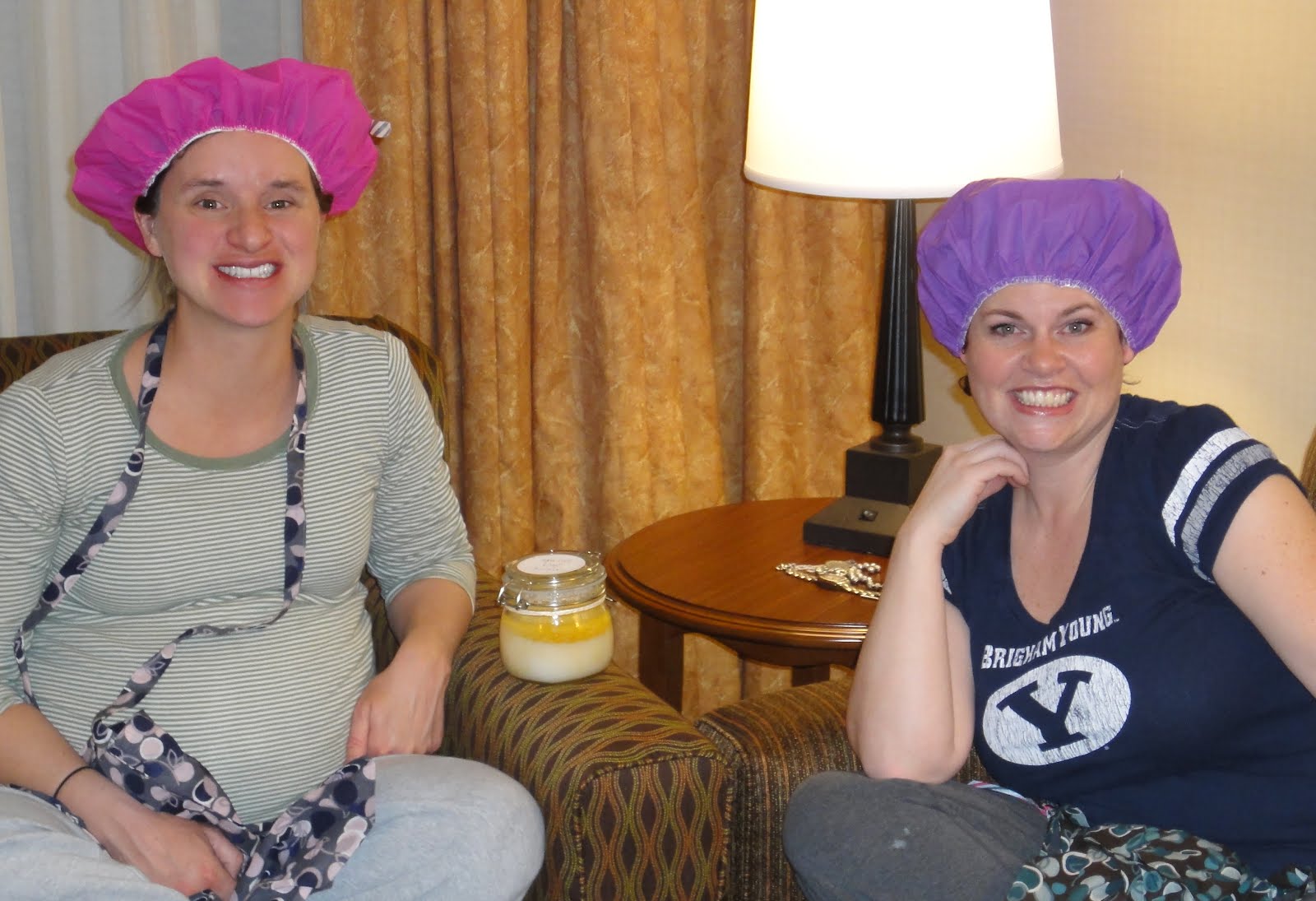
Sista Weekend

Anna, Heidi, Marta, Amy, four of the seven sistas

Want a spa vacay that costs less than a massage?
Split the cost of a local Hampton Inn Suite
and do it yourself!


Bring fancy party decor, tons of drinks and a bundle of Felicity DVDs,


treats and homemade citrus scrub (check w/Marta for the recipe.)


Provide a complimentary foot bather ...


... a rainbow of polish,


deep conditioning peppermint oil,


and facial masks for all.
We had a surprise shower afterwards—


Welcome to the sistahood, baby girl!
(It's a great idea to have daughters.)


Friday, January 13, 2012

Pride of Ownership


"Twelve year old kids can drive boats," Josh informed me when he was almost twelve. "Can we buy one?" "Sure," I told him. "If you earn the money."

With that incentive he found the perfect job in the back of a Boy's Life magazine:

Gift Wrap Salesman Wanted
.
Sell $75 worth of wrapping paper and win a . . .

(oh my gosh, can this be true??)

. . . a boat!

Josh trekked the neighborhood, order form in hand, collecting sales and checks. Within three days the $3.99 package deals added up to a $75 package, and all he had to do was wait for his boat.

Six to eight weeks the magazine said.

Twelve weeks passed and so did boating season.

Most of us forgot all about it.

One night Dee and I came home late to a quiet house. A cardboard box was in shreds on the counter and pieces of styrofoam were stuck to the couch. The kids were all in their beds—except for Josh. He was sleeping on the floor, surrounded by dozens of rolls of Christmas wrap.


He'd gone boating.

Josh's raft provided a fun day on Mirror Lake—two at a time we climbed in and prayed it wouldn't sink. A few months later, at Christmastime, the neighbors started calling to see what had happened to their wrapping paper. (Apparently Josh's talent was in sales, not delivery.) I don't know what happened to the boat after that. Most of us forgot all about it, even Josh.

A couple of weeks ago we visited Josh's family. The kids were already asleep when we arrived late Christmas night, but Christie reported on the festivities of the day, while Josh took our suitcases downstairs. "Chase got a boat," she was telling us, just as Josh called, "You've got to see this!"


It's so fun when your kids have kids who are just like them.


Tuesday, January 3, 2012

Make a Point: Use Yourself as the Bad Example


An Oma (Condensed) Storybook.
A true-ish story taken from Oma's childhood,
illustrated by photos from the Cousin's Club Photo Collection.


"Open wide," said Dr. Hall. I was sitting in the torture chair, with the dentist picking around between my gums. He looked over the holes left where my baby teeth had fallen out. "You have a little mouth," he said. "There's not room for your big teeth to grow in. We'll have to pull a few molars, use elastics and headgear to stretch your mouth bigger." We'll see about that, I thought to my chicken-hearted self. I'm basically a wimp who looks for the easy way off a painful path.
When I got home, I rushed to the mirror, opened wide and peered inside. Bubble gum had turned my tongue a ghastly purple, and I could see nothing pretty in there. Teeth twisted every which way—I needed a bigger mouth, and it wasn't going to be pleasant getting one.

Polly shoved me aside, wanting a turn at the mirror. Floppy white legs dangled over her shoulders with ribbons tied at the feet. My crazy little sister was wearing a pair of tights on her head, pretending she had long braids! "Why are you wearing Suzy-long-legs for hair?" I asked. "You look dopey!" She burst out crying. "You have a big mouth!" she yelled.

A big mouth—just what I needed! Maybe I could develop this skill and avoid some dental pain. It was actually pretty easy. I just said everything I thought, without thinking about it first. By the end of the day my sisters and my dad and brother, had all commented on my big mouth. Words were flying wildly and my tongue was out of control when I found Tommy pitching a pup-tent in the backyard.


"It's going to fall down," I teased. He didn't look up. "You're not a real cowboy," I said, and threw his pint-size ten-gallon on top of the carport. He pulled his cap-gun, but I took my best shot: "The fringe on your shirt is plastic," I whooped. Tommy looked down at his shirt with tear-filled eyes.

"That's enough, young lady," said a dark shadow behind me. "You can spend the rest of the day in your room." Mom's voice was soft and controlled. Mine wasn't.

"I hate you!" I yelled up at her. "I hate you!" I'll never forget the heartbreak in her eyes when I said those words. I had hurt the person who loved me most, even when I was the most unlovable. "I hate you." I said it softer this time, more to myself.

In my room I looked in the mirror. I saw a gargantuan tongue flopping around, out of control, and, just as everyone had told me, a big mouth. Even my teddy bear didn't want to get cozy with all the venom drooling out of my lips.

Mom knocked and then came in and sat on the bed. I couldn't stop looking at her lovely smile. And something I'd never noticed before—she had a crooked tooth!


"My mouth was too little for all my teeth," Mom explained, "and some of them crowded on top of each other. I didn't feel pretty for a long time. That's why I want you to have room for your teeth."

"Will I be pretty?" I asked between sobs.

"You know, Marty, ugly words always make a girl ugly, even if she has lovely lips and terrific teeth. Beautiful words always make a woman beautiful, even if her teeth are all skeewampus.

"Dr. Hall can use elastics and headgear to make your smile perfect, but if you have a big mouth, you won't be pretty." I understood what she meant by a big mouth.

At dinner that night I sat across from Polly. "I like your braids," I told her. Her dimple showed, and I knew my opinion mattered. That made me feel nice, so I said, "You can use my barrettes if you want to." I looked over at Tommy and asked, "Are you sleeping in your tent tonight?" He nodded, and straightened his hat. "Looking good, Cowboy," I said and felt even nicer.

"What did the dentist say, Marty?" Dad asked.

"He said my mouth wasn't big enough," I reported. "There's not much I can do, except be patient while he uses elastics and headgear to make it bigger."

Mom seemed to have forgotten my ugly words. "Marty's lovely lips won't have to hide anything unpleasant in her mouth," she said. "because her words are as pretty as her smile."

Not quite The End.
As Marty grew up, her challenge was always to control her tongue, and keep her big mouth shut a little more often. When she met Dee Halverson he told her his motto:

"Think over everything you say, but don't say everything you think."

Dee always said kind, thoughtful things so Marty decided to marry him. Even though she's now a 62-year-old Oma, she still has trouble controlling her tongue. She's learned to think over everything she says, but it's usually after she's already said it!

Luckily the people she loves are understanding. Her children and grandchildren are her best examples: they are beautiful because they think and say beautiful things. See for yourself!
(Just a few examples of teeth coming in every which way.)
The Cousins are all darling because of the sweet words
that decorate their smiles with love!

An Oma tip:
Tell a story about how you learned (or tried to learn) a lesson one of your posterity is working on right now. You'll have a new bond! It's good for kids to know Mom and Dad, Aunt Clara and Uncle Max and even Great-grandpa Hugh had a few habits to break and new skills to master.
Improvement can be a family affair!


Set a New Year's Goal to work on with a loved one,
just for fun!


Friday, December 30, 2011

Set Your Own Pace!


"Is there really a human race? Is it going on now, all over the place?"


At twenty I started out at my own steady pace.


At thirty I ran faster. I was losing face.


At forty I stumbled late in the day.


At fifty the finish line seemed further away.


At sixty I wonder:
How long is this race, anyway?

Do you ever feel you're running faster than you can?

Years ago a well-meaning teacher set a goal for herself and included the whole class in her challenge. She was going to do a good deed, something extra, outside her normal responsibilities, every day. Each week she passed around a sheet to sign if we'd met the goal, which even included a place to record how many "service hours" we'd given. I was totally caught up in what became a contest to be "the most charitable woman."

Looking back I realize how nutty this was. I had a husband, seven kids and a dog at home who needed to be fed. Bedraggled plants begged for water from their macrame hangers; the dryer beeped endlessly; the closets glared messily, all calling for my attention. Teenagers sat in class every Sunday expecting a lesson, and great-grandmas called, wondering when I was coming to visit. Birthday cakes, haircuts, ear-aches, dance lessons, science projects—none of these counted as good deeds. They were my normal responsibilities.

Although I was running as fast as I could go, I felt like a failure because my to-do list left good deed unchecked more often than not. When the weekly sign-up sheet came around to me, I was embarrassed to pass it on, knowing I looked pretty uncharitable with my meager service hours.

Years later I was in a class on budgeting. The teacher cautioned us about living beyond our means—spending more than we had. Suddenly it dawned on me: I have 24 hours a day. Circumstances already claimed most of them. Setting goals with time I don't have is living beyond my means. One woman's finish line had become my stumbling block.

Misty wrote a cute post about her New Year's Resolutions, reflecting on the baby books she hasn't started since her twins were born. But how many baths has she given? How many late nights and early mornings has she put in? She probably doesn't even have time to count the appointments to the obstetrician, and then the pediatrician, that have kept her kids healthy. Misty's running a different race right now, pushing a triple jogging stroller at full speed.

Don't despair young moms. Someday your course will lead back to your baby books. In the meantime, give yourself a breather, and skip once in a while.


There's no human race. The run itself is the pay.

(Where am I going in such a rush, anyway?)


Monday, December 26, 2011

What Did You Give?

Art by Eloise Wilkin

An African child listened carefully as his teacher explained why Christians give presents to each other on Christmas Day. "The gift is an expression of our joy over the birth of Jesus and our love for each other," she said.

When Christmas day came, the boy brought the teacher a seashell of lustrous beauty. "Where did you ever find such a beautiful shell?" the teacher asked. The child told her that there was only one spot where such extraordinary shells could be found. When he named the place, a certain bay several miles away, the teacher was left speechless. "Why . . . why, it’s gorgeous . . . wonderful, but you shouldn’t have gone to all that trouble to get the gift for me." His eyes brightening, the boy answered, "Long walk part of gift."

When you look at the living room today, and wonder why you worked so many weeks for an event that lasted only one day, remind yourself: "Long walk part of gift."

Monday, December 12, 2011

St. Lucia Day

Marty's Rice Pudding Recipe
Salt Lake Tribune, 1980


Tomorrow is Lucia Day, which (as all Svenska tjejer know) is the beginning of Christmas. Rice pudding is traditional with an almond tucked into the creaminess. (Whoever gets the almond will have good luck in the coming year.) Once I won a newspaper contest with this delicious baked version.

TravelinOma's Rice Pudding
  • 6 eggs
  • 3 Tablespoons honey
  • 1 cup sugar
  • 1 teaspoon nutmeg
  • 2 teaspoons cinnamon
  • 1 teaspoon vanilla
  • 1 cup heavy cream
  • 2 cups milk
  • 3 cups cooked rice
Beat eggs until lemony in color. Add honey, sugar and spices; mix well. Stir in vanilla, cream, milk and cooked rice. Pour into a two-quart casserole. Bake at 325 degrees for 45-60 minutes until a knife comes out clean. (A custard rises to the top.)

Saint Lucia could serve the warm pudding with rolls and cocoa. She's another Swedish tradition.

Heidi as St. Lucia 1986

Every December 13th I made a crown out of a paper plate, clipped on little red candles, placed it on the head of one of my precious daughters and LIT IT ON FIRE! Little Swedish girls have done it for centuries—singed hair is the price of our heritage. There are many versions of the Lucia legend. This is the one I've passed down:

Saint Lucia and the Star Boys

Lucy was a young Christian girl martyred for her beliefs centuries ago in Rome. She was made a Saint, and remembered as St. Lucia in the Scandinavian countries. One especially dark and hopeless December the people in a poor village were starving. From across the lake they could see a blaze of brightness coming toward them. It was Lucia, her blond hair encircled by a halo of brilliant light, wearing a white robe with a red sash, bringing them bread. She was accompanied by young boys, their faces also illuminated as if by the stars, hauling sacks of food.

Since then the day has been celebrated as the Festival of Lights in Sweden. In some families the oldest daughter wakes up before dawn, and prepares a breakfast tray for her parents. She dresses in a white robe with a red ribbon sash, and wears a crown of candles. Her younger brothers play the part of the Star Boys, also wearing white, carrying pictures of stars. This is the start of Christmas festivities in their home.

For me, St. Lucia symbolizes the light Jesus Christ brings to the world, and the Bread of Life He provides for us. He gives a dark world hope. It's a lovely way to remember the reason I celebrate Christmas.


(Eventually we got a safe replica of a St Lucia Crown. It had fake candles lit with batteries.)


God yul!

Thursday, December 8, 2011

Yes Mom, There is a Santa

Art by Norman Rockwell

Today my alter ego, Kirby Puckernut, wrote a post answering the question "Is Santa Claus real?" (Personally, I've never doubted.) I love the true story of a little eight-year-old girl who wrote to the New York Sun in 1897 asking the same question.

“Quite naturally I believed in Santa Claus," said Virginia O'Hanlon. "He had never disappointed me. But when less fortunate little boys and girls said there wasn’t any Santa Claus, I was filled with doubts. I asked my father, and he was a little evasive on the subject.

“It was a habit in our family that whenever any doubts came up as to how to pronounce a word or some question of historical fact was in doubt, we wrote to the Question and Answer column in The Sun. Father would always say, ‘If you see it in the The Sun, it’s so,’ and that settled the matter.

“ ‘Well, I’m just going to write The Sun and find out the real truth,’ I said to father.

“He said, ‘Go ahead, Virginia. I’m sure The Sun will give you the right answer, as it always does.’ ”

And so Virginia sat down and wrote her parents’ favorite newspaper.

Her letter found its way into the hands of a veteran editor, Francis P. Church. Son of a Baptist minister, Church had covered the Civil War for The New York Times and had worked on the The New York Sun for 20 years, more recently as an anonymous editorial writer. When controversal subjects had to be tackled on the editorial page, especially those dealing with theology, the assignments were usually given to Church.

Now, he had in his hands a little girl’s letter on a most controversial matter, and he was burdened with the responsibility of answering it.

“Is there a Santa Claus?” the childish scrawl in the letter asked. At once, Church knew that there was no avoiding the question. He must answer, and he must answer truthfully. And so he turned to his desk, and he began his reply which was to become one of the most memorable editorials in newspaper history.


Yes, Virginia, There is a Santa Claus

By Francis P. Church, first published in The New York Sun in 1897.

Dear Editor—

I am 8 years old. Some of my little friends say there is no Santa Claus. Papa says, “If you see it in The Sun, it’s so.” Please tell me the truth, is there a Santa Claus?

Virginia O’Hanlon

Virginia, your little friends are wrong. They have been affected by the skepticism of a skeptical age. They do not believe except they see . . .

Yes, Virginia, there is a Santa Claus. He exists as certainly as love and generosity and devotion exist, and you know that they abound and give to your life its highest beauty and joy. Alas! how dreary would be the world if there were no Santa Claus! It would be as dreary as if there were no Virginias. There would be no childlike faith then, no poetry, no romance to make tolerable this existence. We should have no enjoyment . . . the eternal light of childhood that fills the world would be extinguished.

Not believe in Santa Claus! You might as well not believe in fairies. You might get your papa to hire men to watch in all the chimneys on Christmas eve to catch Santa Claus, but even if you did not see Santa Claus coming down, what would that prove? Nobody sees Santa Claus, but that is no sign that there is no Santa Claus. The most real things in the world are those that neither children nor men can see. Did you ever see fairies dancing on the lawn? Of course not, but that’s no proof that they are not there. Nobody can conceive or imagine all the wonders there are unseen and unseeable in the world . . .

Santa Claus! He lives and will live forever. A thousand years from now, Virginia, nay 10 times 10,000 years from now, he will continue to make glad the heart of childhood.

Kirby said that Santa is as real as you want him to be.
I want him to be very real!
(I can't imagine getting Christmas ready without him.)

What do you think?
How do you answer the question
"Is Santa Claus real?


Thursday, December 1, 2011

Extended Family Christmas

Glancing at each other with sucked in grins, we tried not to giggle out loud. Our feet didn't touch the floor as we left the doctor's office that December 11, 1969, and burst out laughing, hugging each other before the door closed. It was true! Next year we would be known as Santa Claus to someone! We were going to have a baby.

We'd been married three months, and it was our first Christmas together. We were still kids ourselves, 20 and 23, and we were over the moon with excitement. Our own family. How could we celebrate such an eternal occasion? With an evergreen tree!

It fit in the corner of our 8' x 35' trailer (we're talking a pretty skinny tree) but it was green and crisply frozen; when it thawed out we swooned with the smell of fresh pine. We couldn't afford lights or ornaments, so we were creative. Strands of popcorn, and tissue paper snowflakes were hung, along with Christmas cards held on by fat red yarn bows. Even the cost of a package of cranberries stretched our budget too far, so Dee surprised me by stringing red pyracantha berries from the bushes near our mailbox. They shriveled within hours, so every morning he threaded new ones for fresh garlands.

Over our forty two Christmases we've had a forest of Christmas trees, but no tree stands out in my memory like our first one. It was like our marriage: it represented love, hope, effort, dreams and new traditions.

Christmas Eve we announced our good news by singing at the family party:
♬For unto us a child is born; unto us a son/daughter is given. ♬

(We each sang our own prediction.) It was snowing, so we left early and drove home for our own cozy celebration. After reading the Christmas story in Luke 2 we hung our brand-new, home-made stockings on the knobs of the stove and went to bed.

I'll admit, I wanted to stay at my mom's that first year, until I saw Dee's enthusiasm for our own Christmas. I couldn't imagine being away from my family on Christmas morning. Mom's Christmases were something from a fairytale, and Dad always had surprises on top of surprises. It took us a couple of hours to open our presents, and then our grandparents arrived with more. There were fires in both fireplaces, Mom made a lovely buffet in the dining room and Dad gave away cash prizes during football half-times.

I felt torn. I was the first kid to leave home and miss the big family event, and my parents were urging us to stay overnight. (Urge is a mild word—it was somewhere between insist and command.) They didn't support my new family when it upset their old family traditions. I felt traitorous choosing my little family over theirs, and I resented them for making it awkward to choose. I don't think that was their intention, but it was the result. Their lack of enthusiasm for our humble celebration encouraged me to resent Dee for hauling me away from their warm hearth to our chilly coal-oil hot plate.

I'm sure many newly-weds experience the same tug-of-war between childhood memories and adult responsibilities. It's easier to stay in mom and dad's Garden of Eden, than venture off into the cold and dreary world and work to plant a garden for ourselves. But it's a main part of the plan of happiness.

I love the quote that advises parents to "Hold your loved ones to you with wide open arms." It was our turn to start traditions, and Dee was anxious to have our first year together as just a couple—we'd never have it again. My folks were hurt and mad, as they often were when we began "tearing their family apart," (mom's words.) During those years we wondered: Why do we have to debate and defend our efforts to strengthen our marriage and home to our own parents, who ought to be thrilled we're trying to do that very thing!

I had wonderful parents, but they viewed me as theirs, even when I wasn't anymore. It caused a lot of stress, sapped my confidence, created conflict between me and Dee, and resulted in hard feelings that were difficult to overcome. From that first year we started setting goals for when we had adult children, hoping to avoid adding pressure and anxiety to our kid's lives.
  1. We will be enthusiastic and support their choices, always, and congratulate them on making tough decisions, never second-guessing.
  2. We won't throw cold water on their dreams with all our supposed wisdom.
  3. When we tell them they're so awesome, they could do anything, we'll actually let them do the thing they choose to do.
  4. We'll remember it's their life—their chance to make decisions (even wrong ones,) their chance to set priorities, their chance to learn it all line upon line, here a little and there a little, and our chance to stand back and enjoy it all from a distance.
  5. We will plan for and develop interests that will keep us occupied so we don't have tons of free time to try to live their lives for them. We'll be available when they want us, and thick-skinned when they don't.
I started stressing over next-year's holiday the day after Christmas. How could I explain to mom how we felt, and not have it turn into a debate or a lecture? Or worse, hurt-feelings and comments like, "Grandma said she hopes she dies before you stop coming to the Christmas Eve party."

There was no understanding of the difficulty of dragging seven kids away from their Christmas whatever and keep them entertained (during the most hyper time of year) and well-behaved in a beautifully appointed house full of valuable keep-sake decorations, surrounded by a bunch of adults the kids don't know and who are annoyed by the chaos kids live in.

I've gotten carried away. It's 4:00 am and I'm leaving for Denver at 8:00 am! You're going to have to carry on this discussion! What do you think? We need opinions from all sides of the issue. Comment!!!

And, on a more festive topic: Where do you find Christmas magic? I'm ghostwriting a blog this season—my pen name is Kirby Puckernut and I'm one of Santa's elves. Click here for a sleigh full of fun Christmas ideas! Please visit—Kirby's more light-hearted than me today!